
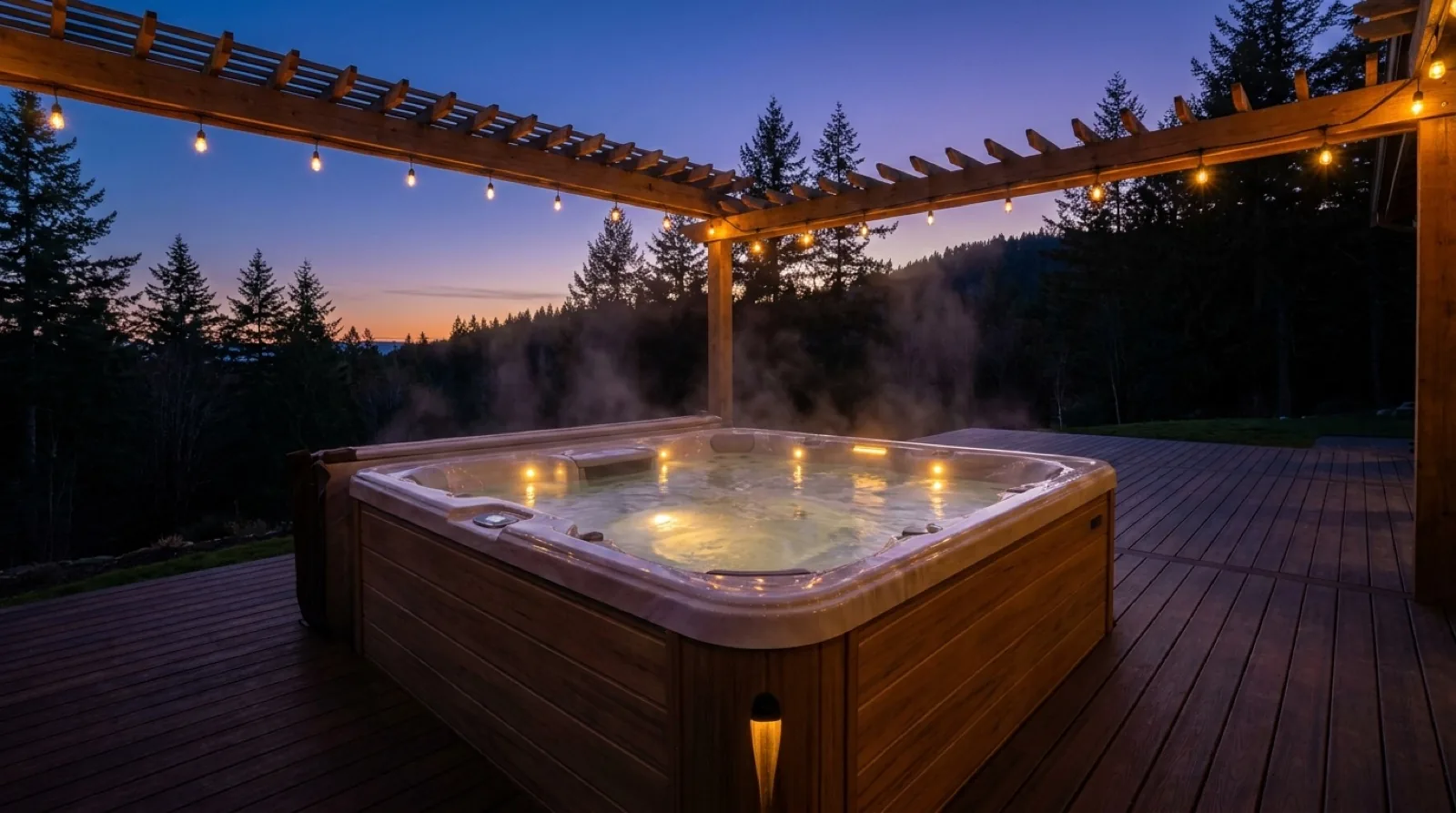
Most new hot tubs sell for roughly $5,000 to $16,000 depending on size, insulation and features, and the sticker price is only part of the number. Plan on a pad, a 240 volt electrical hookup and delivery on top of that, then about $30 to $60 a month for power, chemicals and filters once it is running. ASA Pools & Spas services spas across Seattle every week, so below is how those costs actually break down for owners here.
Monthly running cost is where the Pacific Northwest gets a real break. The U.S. Energy Information Administration consistently ranks Washington among the cheapest states in the country for residential electricity, in the neighborhood of 12 cents per kilowatt hour against a national average closer to 17 cents. That single fact is why the scary hot tub bills you read about online rarely apply in the Puget Sound area.
What does the average hot tub cost?
Hot tubs sort into fairly predictable price tiers. Inflatable and soft sided tubs run a few hundred dollars to about $1,000, and they work as a trial run rather than a long term spa. Plug and play models that run on a standard 110 volt outlet generally land around $4,000 to $8,000, seat two to four people and heat slowly, which matters more in a damp Seattle winter than most buyers expect.
The middle of the market is where most families end up. A quality 240 volt acrylic spa seating four to six typically costs about $8,000 to $13,000, and that is the honest answer to what a good hot tub costs. Premium tubs with full foam insulation, lounge seating, salt water systems and stronger warranties usually start around $13,000 and climb past $20,000.
Swim spas and in ground spas are a different category again, commonly $20,000 and up, and a gunite spa built alongside a pool is priced as part of the pool project. If you are weighing a swim spa or a cold plunge, our cold plunge and swim spa service page covers what those units need once they are in the yard.
How much does it cost to install a hot tub?
Installation is the cost people forget. A hot tub full of water and people weighs several thousand pounds, so it needs a level base: compacted gravel with pavers, a prefabricated spa pad, or a poured concrete slab. Gravel and pavers are the budget route, a slab costs more and lasts forever, and a deck installation needs a structural check before anything gets delivered.
The bigger variable is electrical. Anything above a plug and play model needs a dedicated 240 volt circuit with a GFCI disconnect installed by a licensed electrician, and the price swings with how far the tub sits from your panel and whether that panel has capacity left. A short run in an older Seattle home with a full panel can cost noticeably more than a long run in a house with a modern service, so get that quoted before you sign for the spa.
Then there is delivery. Many Seattle lots are narrow, sloped or stair access only, and neighborhoods like Queen Anne, Capitol Hill and West Seattle regularly need a crane lift over the house instead of a straight roll through the side yard. Crane work adds real cost, so measure your access early. We handle site prep questions and hot tub installation across the Puget Sound area if you want the whole thing scoped in one visit.
How much does a hot tub cost per month?
For a modern, well covered spa in the Seattle area, expect roughly $30 to $60 a month all in. Electricity is usually $15 to $35 of that, which we break down in detail in our guide to how much electricity a hot tub uses. Chemicals add something like $15 to $25 a month, and filters are a couple of replacements a year.
Water is the small line item almost nobody counts. Draining and refilling every three to four months uses a few hundred gallons, which on Seattle Public Utilities rates is a modest one time bump rather than a real expense.
Older tubs with tired covers are the ones that blow past this range. If your spa is costing $80 or $100 a month to run, that is not the normal price of ownership, it is heat escaping somewhere, and it is usually fixable.
What about maintenance, covers and repairs?
Covers are the recurring replacement item. A quality cover generally lasts five to seven years in our wet climate before it absorbs water and starts leaking heat, and replacing one costs a few hundred dollars. It is also the single upgrade that pays for itself fastest, because a saturated cover quietly raises the power bill every night.
Beyond that, budget for the occasional part. Circulation pumps, heater elements, sensors and control packs all have a service life, and one repair every few years is normal for a spa that gets used. Regular hot tub maintenance keeps those events small, since most expensive failures start as a dirty filter, low flow or water chemistry that quietly ate a heater element.
If you would rather not handle water testing and filter cleaning yourself, a service plan is generally cheaper than a single emergency hot tub repair call, and it keeps the warranty conversation simple if something major does fail.
Is a used hot tub cheaper?
Sometimes, and sometimes it is the most expensive tub on the block. Used spas show up cheap or free on local listings all the time, but the seller rarely knows the condition of the pump, heater or foam. A tub that was left unheated through a Northwest winter may have frozen and split lines, and a leak buried in full foam insulation is one of the harder repairs to chase.
Then there is moving it. A hot tub is heavy, awkward and often has to come out over a fence or up a flight of stairs, which means a crew, a dolly and occasionally a crane. Add the electrical hookup at the new house and a free tub can end up costing more than a modest new one.
If you are buying used, get it powered up and running before money changes hands, and check for error codes, weeping fittings and a cover that is not waterlogged. And when the old tub finally dies, someone has to haul it away, which is why we offer hot tub removal and disposal as its own service. Cost there depends entirely on access and disposal, so we quote it free.